
The Mossmorran complex is near Cowdenbeath and Lochgelly in Fife. It includes two main petrochemical facilities:
- Fife Natural Gas Liquids (Fife NGL), operated by Shell U.K. Limited
- Fife Ethylene Plant (FEP), operated by ExxonMobil Chemical Limited
These facilities form part of the UK’s petrochemical infrastructure. Products are exported via the nearby Braefoot Bay Marine Terminal.
What happens at the site
The Mossmorran complex processes natural gas into products used across the UK and internationally.
- Natural Gas Liquids (NGLs) are delivered from the St Fergus gas terminal
- At the FNGL plant, they are separated into propane, ethane, butane and natural gasoline
- Ethane is transferred to the FEP, where it is converted into ethylene using high-temperature processing
Products are then:
- distributed across the UK via pipelines
- exported via Braefoot Bay
The Mossmorran and Braefoot Bay facilities are subject to a comprehensive regulatory framework.
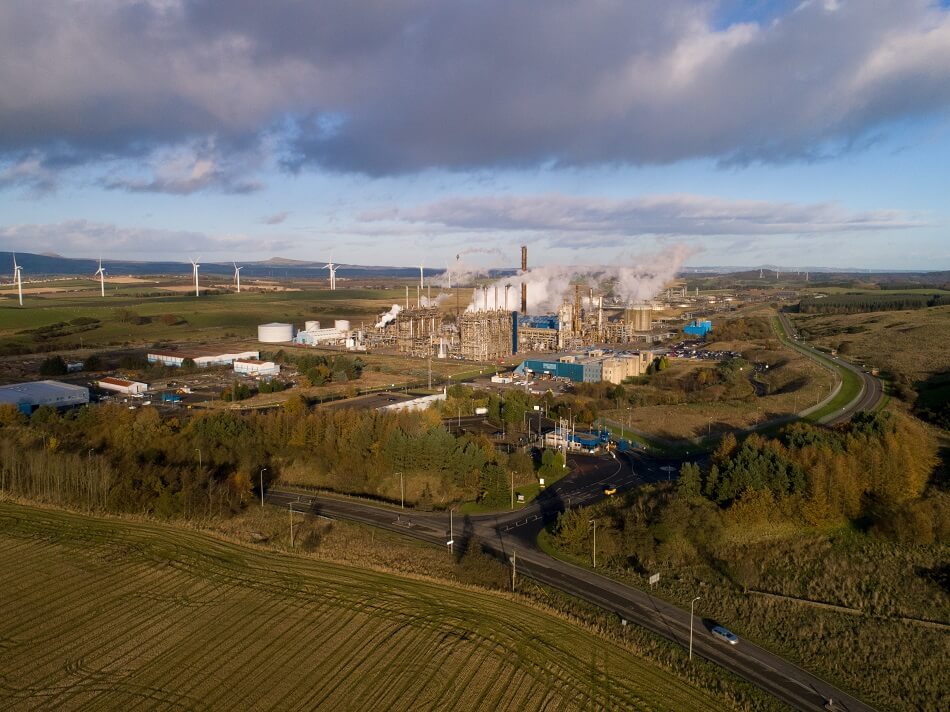
(Image courtesy of SEPA)
Who regulates Mossmorran?
The site is regulated by:
- Health and Safety Executive (HSE), which regulates major hazard safety
- Scottish Environment Protection Agency (SEPA), which regulates emissions to air, land and water
These organisations monitor performance, investigate incidents and take enforcement action where needed.
Air quality and environmental responsibilities
Different organisations have different responsibilities:
- SEPA regulates emissions from the site and controls activities such as flaring
- Fife Council has a legal duty to review and assess air quality across Fife
This includes:
- monitoring local air quality
- checking compliance with national air quality objectives
- publishing reports
Current air quality position
Air quality in the Mossmorran area is regularly monitored and independently assessed.
- Data is reviewed by the Air Quality Expert Advisory Group
- Findings are reported annually through Fife Council
- Current assessments show that air quality objectives are being met
Flaring events are regulated by SEPA.
Fife Council’s role
Fife Council provides oversight, independent review and coordination of local environmental and public health matters.
This includes:
- reviewing air quality data and reports
- advising elected members and committees
- supporting community engagement
- working with SEPA, Public Health Scotland and NHS Fife
Community oversight and governance
A formal structure is in place to ensure transparency and accountability.
Community and Safety Committee
This committee:
- acts as the main forum for community concerns
- receives reports from regulators, operators and advisory groups
- oversees site performance
Expert Advisory Groups (EAGs)
Three specialist groups support the committee:
Air quality:
- reviews monitoring data and independent analysis
- advises on monitoring and interpretation
- reports findings to the committee and Fife Council
- reviews monitoring and mitigation arrangements
- works alongside SEPA’s regulatory role
Communications:
- supports clear and consistent public information
- improves communication during incidents
Together, these groups provide independent scrutiny, technical advice and public transparency.
Incidents and public information
During events such as flaring:
- SEPA regulates site operations
- monitoring data is reviewed to assess environmental and public health impacts
You can report environmental concerns to SEPA’s 24-hour Pollution Hotline on 0800 807 060.
Reports and meetings
Find reports and meeting notes for Mossmorran and Braefoot Bay. We publish information from the last 2 years.
To request older reports or meeting notes, email air.quality@fife.gov.uk
Air Quality Expert Advisory Group action points are included within Community and Safety Committee meeting notes.
Independent Air Quality Expert Advisory Group 2025 Annual Report
Annual Progress reports:
- 2025 Annual Progress Report
- 2025 Summary Progress Report
- 2024 Annual Progress Report
- 2024 Summary Progress Report
Community and safety committee meetings
View recent Community and Safety Committee meeting notes.
- Minutes - November 2025
- Minutes - August 2025
- Minutes - May 2025
- Minutes - March 2025
- Minutes - November 2024
- Minutes - August 2024
- Minutes - May 2024
- Minutes - February 2024
Community and safety committee constitution and terms of reference
